Tesla Model Y Standard LFP Charging Test: What Happens When You Plug In Almost Full
I had a Giga Berlin-built Tesla Model Y Standard with an LFP battery for one day and ran three DC fast-charging sessions starting at a high state of charge. Here is what it pulled at 68%, 80% and even 94%, and why it changes how you plan road-trip stops.
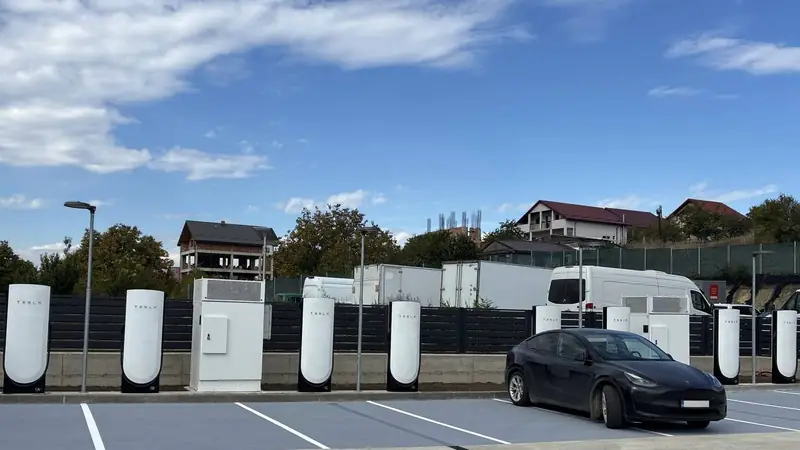
Every EV driver learns the same rule early on: the fuller the battery, the slower it charges. That is why most of us drive a long trip down to a low percentage before stopping at a fast charger. When I got a Tesla Model Y Standard built at Giga Berlin, with an LFP battery, for a single day, I wanted to test the opposite. What happens if you plug it in at 68%, at 80%, or even at 94%? The answer, filmed for my YouTube channel "Mașina Timpului", genuinely surprised me.
The car and its battery
The Model Y Standard is the entry-level, rear-wheel-drive version of Tesla's SUV. According to the European launch data reported by the German magazine "Elektroautomobil", it is rated at up to 534 km (332 miles) WLTP, 13.1 kWh/100 km, and a peak DC charging power of 175 kW on a 400-volt architecture.
Tesla does not officially name its cell supplier, but rear-wheel-drive Model Ys from Grünheide have used BYD's Blade-type LFP cells for several years, as "Electrek" reported back in 2023 and "electrive" confirmed in a later test. Even then, early owners noticed the BYD pack held its peak power longer than the earlier LFP version. I did not take anything apart, so I am relying on those reports and on what the screen showed me.
One important caveat: in all three tests the battery was warm. I preconditioned before every stop, because a cold LFP pack charges far more slowly. These numbers do not apply to a car that sat outside overnight and was plugged straight in.
Test 1: starting at 68%
I arrived at a 150 kW charger with 68%. Right after plugging in, the car pulled about 145–149 kW, essentially everything the charger could deliver. After roughly three minutes it was at 76% and the power had eased to about 105 kW. Between 68% and 80% the average was around 108 kW, and at 80% the car was still taking roughly 80–100 kW.
In the app, a short session of about five and a half minutes averaged close to 100 kW with a peak of about 127 kW at the charger. In that case the battery was not fully up to temperature, and the car even displayed a message saying charging was limited by battery temperature.
Test 2: from 80% to 100%
The second session was on a 120 kW charger, starting at 79%. After a few seconds of ramp-up, power settled at about 113 kW, the charger's limit. At 93% the car was still pulling around 62 kW, and after seven minutes it had added almost 10 kWh. Only above 98–99% did power drop to a few kW, as the car moved into its battery calibration phase.
At 100%, the display showed 448 km of estimated range. Keep in mind Tesla bases that figure on rated consumption, not on my own driving.
Test 3: plugging in at 94% with a well-warmed battery
I wanted to see how far this goes, so I preconditioned the battery for about 20 minutes and plugged in at 94%. Peak power was about 147 kW. In 2 minutes 47 seconds I was at roughly 99%, with 3.35 kWh added. At 96% it was still above 100 kW, and at 98% around 50 kW. I have not seen that from any other car I have tested, including 800-volt models.
Why I think it matters
My view is that this is not just a good charging curve but a deliberate charging strategy: every new session seems to start with a burst of peak power regardless of state of charge, then taper off. For comparison, my own Tesla Model 3 Dual Motor with an NMC battery starts much more slowly if I plug it in at 70%.
In practice, with a car like this you no longer need one long bottom-to-top stop. You pull in for a coffee or groceries, plug in for ten minutes, and leave nearly full again with a warm battery. In winter that also helps efficiency, because the pack stays at a good temperature.
From the figures shown in the car, the rated consumption of this Model Y Standard also came out slightly lower than my Model 3's, even though the Model Y is bigger. That is not a real-world efficiency test, but it is an interesting hint. For measured highway figures, see my separate Model Y Standard highway efficiency test.
What it means for drivers
Charge often, not only when you are nearly empty. With an LFP Model Y Standard, short stops at any fast charger can keep the battery close to full throughout a trip.
Preconditioning is essential. Every strong result above came with a warm battery. Set the charger as your navigation destination or start battery warm-up manually before you arrive.
Charging to 100% is fine on LFP. Tesla's official owner's manual recommends that cars with LFP batteries keep their charge limit at 100%, even for daily use, and charge fully at least once a week so the car can estimate range accurately. The last percent can take a while because the car is calibrating, so on a trip it is not worth waiting for it.
Results depend on the charger. I only used 120 kW and 150 kW units. On a more powerful Supercharger, the opening power could be higher. I plan to repeat the test on a long drive with a short stop at every charger to see whether the pattern holds.
If you want to understand why most cars slow down at high percentages, read my guide to the DC charging curve. Thanks to Tesla Romania for the test car.


