Battery close to 0% on the road: how far you can still go and how to reach a charger calmly
A practical guide: the warnings your EV gives you, what the ADAC test showed about the reserve below 0%, how to gain kilometres with Eco mode, lower speed and less climate control, which apps lead you to a charger, and why an EV travels on a flatbed.

Watching the battery percentage slide towards zero with the charger still some way off? The good news: electric cars warn you early, keep a small reserve even below 0%, and a few simple adjustments win you precious kilometres. Here is what works.
Your car warns you in stages
"ADAC" drove six EVs until they stopped at the former Penzing air base: VW ID.3, Tesla Model Y, Kia EV6, Volvo EX40, BYD Seal and Nio EL6. All followed the same pattern. First comes a message on screen, and on some cars the battery icon turns orange. The Kia gave its first alert at 21% (about 70 km left), the Volvo only at 7%. Audible warnings follow. Once the remaining range drops to a single digit, many cars cut power, and some light up a "turtle" symbol.
The reserve below 0%
In the "ADAC" test, none of the cars stopped at 0%. All of them kept going for roughly 15–20 km on an emergency reserve, with steadily falling power. "ADAC" stresses that the test ran in ideal conditions, with good weather, a flat road and new cars. In winter or with an older battery, the reserve can be smaller. Treat it as a safety net, not part of the plan.
How to gain kilometres
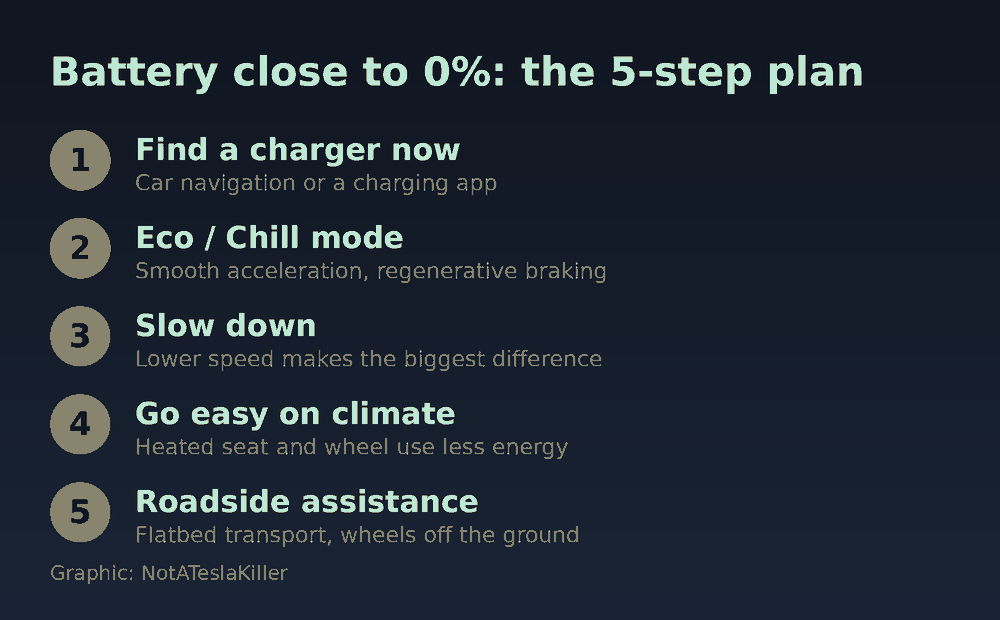
- Slow down. Lower speed makes the biggest difference, especially on the motorway.
- Switch on Eco mode, or Chill on a Tesla, and accelerate gently. Let regenerative braking slow the car and recover energy.
- Go easy on climate control. Tesla's manual notes that heated seats and a heated steering wheel use less energy than heating the cabin.
Let the navigation find the charger
Many EVs look for chargers on their own. On a Tesla, Range Assurance shows a message when you risk leaving the range of known charging locations. It offers a list of chargers you can still reach, guides you there and shows the energy you will have on arrival. On your phone, AmpWhere shows real-time availability and prices for charging stations in Romania, while iHunt EV guides you to its network's stations and lets you pay in the app. Tesla Superchargers also welcome many non-Tesla EVs: see our guide.
 Graphic: NotATeslaKiller
If you do stop: roadside assistance and the flatbed
Pull over somewhere safe and call your carmaker's or insurer's roadside assistance. An EV travels on a flatbed, with its wheels off the ground. Tesla's manual explains why: the motors generate power when the wheels spin, and towing with the wheels on the ground can cause overheating and damage. Kia's EV6 manual also calls for a flatbed or wheel dollies, and AWD versions must never be towed with wheels on the ground. "ADAC" likewise advises against pushing or rolling a stranded EV.
What it means for drivers
- Warnings come early: treat the first message as your cue to pick a charger.
- The reserve below 0% meant roughly 15–20 km in the "ADAC" test. It is a safety net.
- Lower speed, Eco mode and less climate control are the easiest kilometres you can win.
- Your car's navigation, AmpWhere and iHunt EV lead you to the nearest charger.
- A flatbed is the right way to transport an EV.

