How to import a used EV from Germany to Romania: checks, paperwork, RAR and registration
A practical step-by-step guide: what to check before buying a used EV in Germany, which documents you need there, how to get the car home and how to register it in Romania, with fees checked against official sources.

Germany is the biggest used-EV market nearby, with plenty of choice and well-kept cars. Moving one to Romania is easier than it looks once you know the order of the steps. We checked the procedures and fees on the official websites of RAR, the Romanian Interior Ministry, ANAF and ADAC.
1. What to check before you buy
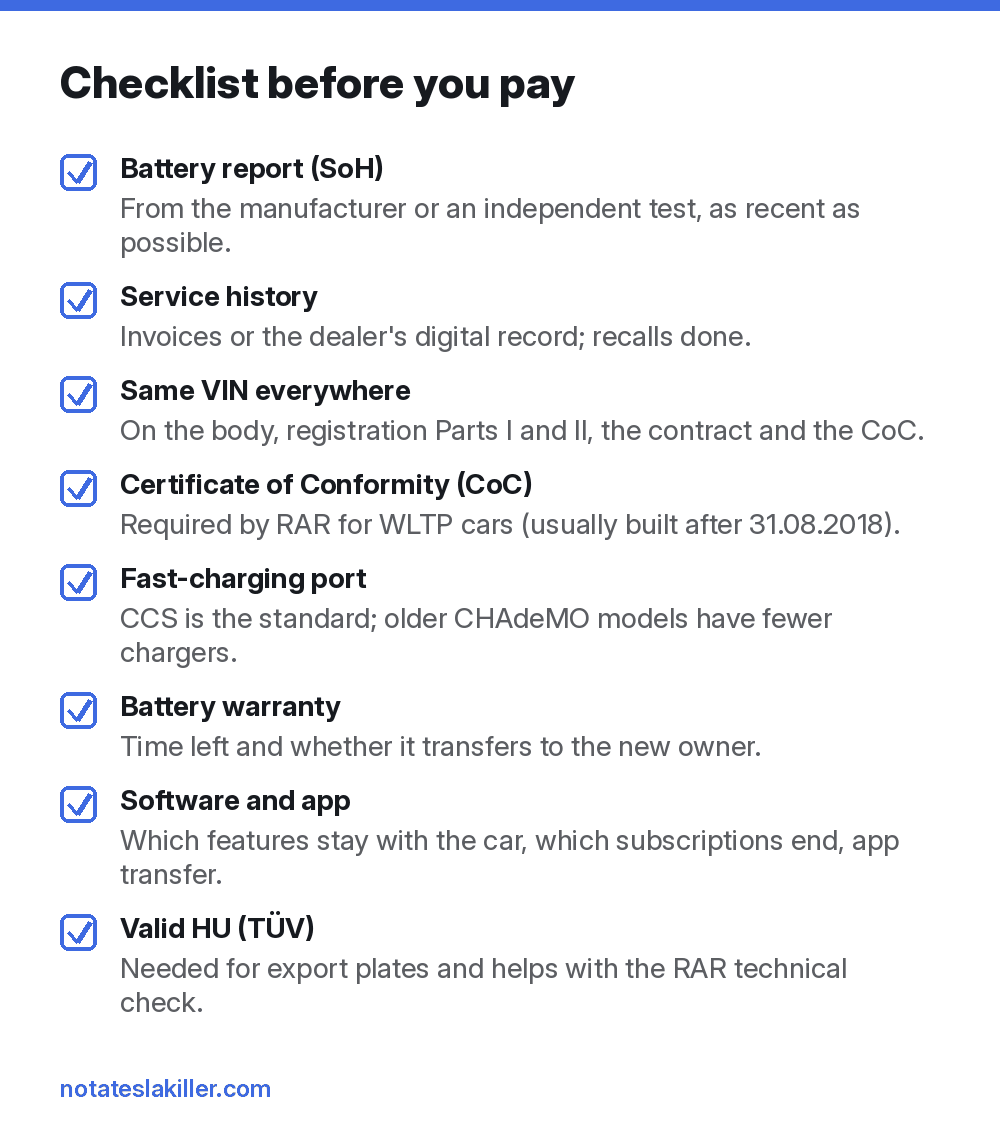
- The battery. Ask for a recent state-of-health (SoH) report, from the manufacturer or an independent test. Details are in our SoH guide.
- Battery warranty. Find out how long it still runs and whether it transfers to the new owner.
- Service history and VIN. The number on the body must match the papers, the contract and the CoC.
- Certificate of Conformity (CoC). RAR requires it for WLTP-certified cars, usually those built after 31.08.2018.
- Fast-charging port. CCS is the standard. Older CHAdeMO models have far fewer chargers.
- Software and app. Some features belong to the car, others to the owner's account, and connectivity subscriptions may end when ownership changes. On a Tesla, check in the app which packages the car has (for example Enhanced Autopilot or FSD). Keep in mind that feature availability differs by country; see our FSD in Europe guide.
 Graphic: notateslakiller.com
2. The German paperwork
You need the sales contract (Kaufvertrag) or invoice, plus Zulassungsbescheinigung Teil I and Teil II (the registration certificate and title). Keep the latest HU report (the roadworthiness test, often called TÜV). RAR can transcribe a valid EU roadworthiness test if you bring the original certificate.
3. Getting it home
There are two options:
- Export plates (Ausfuhrkennzeichen). You apply at a German registration office. You need ID, the car's papers, special export insurance and an HU valid for the whole plate period, which can be at most 12 months. The fee starts at €31.40 in Bavaria, according to "BayernPortal". "ADAC" puts the plates at around €20–40, and insurance is extra.
- Transport by trailer or carrier. No German plates or insurance needed.
Note: German temporary (yellow-edged) plates are meant for use within Germany. "ADAC" explicitly warns that they can cause problems at checks in Romania.
4. Registering in Romania
- ANAF. As a private buyer, you ask the tax office for a VAT certificate. A car counts as "new" if it is under 6 months from first use or under 6,000 km. In that case you pay VAT in Romania. Above both thresholds no Romanian VAT is due, and the certificate confirms it. You apply at your local tax office with the purchase document and proof of first registration; foreign documents need a certified translation.
- RAR. Book an appointment for the CIV (the Romanian vehicle identity card). For an EU car with European type approval and no modifications, RAR issues the CIV directly and carries out the technical check and authenticity certification. The authenticity certificate is valid for 60 days. The fee depends on the vehicle category and approval, and you see it when you book.
- Local taxes. Register the car with the local tax office where you live. Since 2026, the buyer must have no outstanding local tax debts. EVs pay 40 lei a year in vehicle tax under art. 470 of the Fiscal Code.
- Registration (SPCRPCÎV). Bring the foreign papers, plates and translations, compulsory liability insurance (RCA), the CIV, the authenticity certificate and proof of roadworthiness. The registration certificate costs 76 lei from 15.09.2026, and standard-number plates cost 40 lei.
Costs in short
There is no pollution tax at registration: the environmental stamp was abolished in 2017. The Rabla scrappage programme doesn't apply, because it only funds cars that have never been registered. The big costs are transport and, if you use them, export plates.
What it means for drivers
With your paperwork in order, an EV from Germany can be on Romanian plates within days. Once home, plan trips with our long-distance guide, find chargers on AmpWhere and make the most of regenerative braking in town.


